
AI GTM Agents are trending: Are They Worth the Price?
This month, while adding more AI agents for buyer signals and business development to Mardex, we noticed how quickly this category was filling up. Most products made some version of the same promise: find buyers earlier and automate more of a BDR's work. Their prices were rarely trivial, which led to a natural question: are they worth the price?
To answer it, we selected ten representative products already catalogued during Mardex's category research: FullEnrich, LeadMagic, BetterContact, Databar, Baseloop, RB2B, Breakout, Warmly, Unify, and Common Room. Together they provide a sample of how the category defines the work, sets the price, and reports success. Here is what we found.
What are the ten products actually selling?
Although all of them promise to automate business development, we found three clusters. The first builds prospect records: FullEnrich, LeadMagic, and BetterContact focus on verified contact data, while Databar and Baseloop add research, scoring, and CRM workflows. The second acts on website traffic: RB2B identifies visitors, while Breakout and Warmly qualify them, start conversations, route them, and hand them to reps. The third connects signals to outbound execution: Unify and Common Room combine account signals with research, prioritization, and outbound workflows.
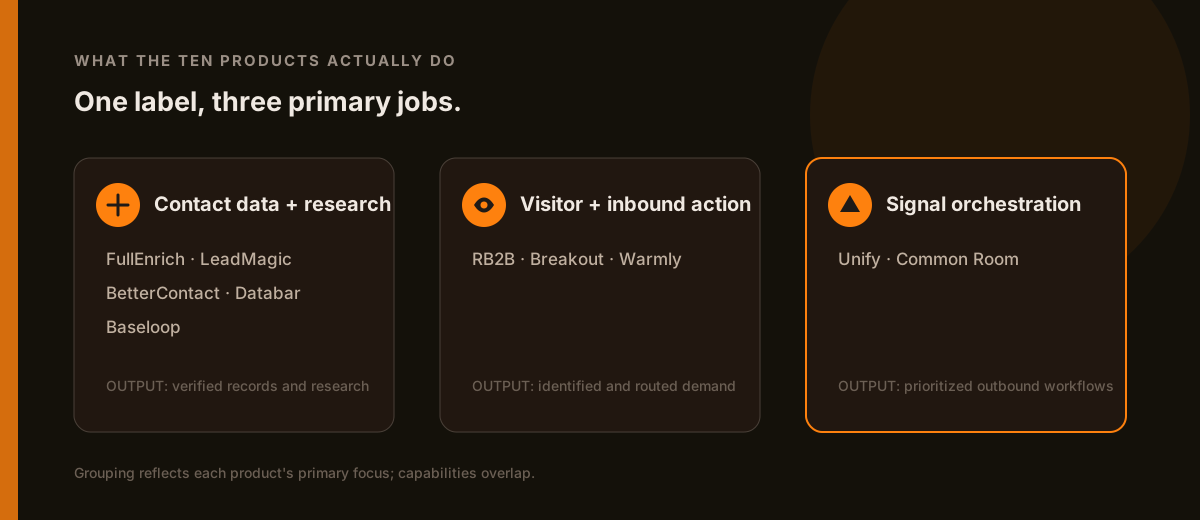
The shared label hides how much work each product owns. Returning a verified email is a smaller job than selecting an account, researching it, starting outreach, and updating the CRM.
Why can one agent cost $30,000 a year?
The price begins with the unit being sold.For example, BetterContact charges $15 per month for 200 valid emails or 20 mobile numbers. While most other enrichment tools sell "credits", but each vendor controls the definition. Buyers therefore have to translate credits into the expected cost of a valid record or completed task.
When it comes to action, the price raises significantly. Breakout starts at $500 per month for identification and $2,000 when an inbound AI SDR, routing, and handoff are added. Warmly and Common Room both reach a $30,000 annual starting point for broader inbound or orchestration work. RB2B remains closer to the resolution model, while Unify combines seats, credits, and custom pricing.
Data note: Pricing and business data in this section were captured from vendor pages available by July 31, 2026. Both can change. Verify current figures with the vendor.
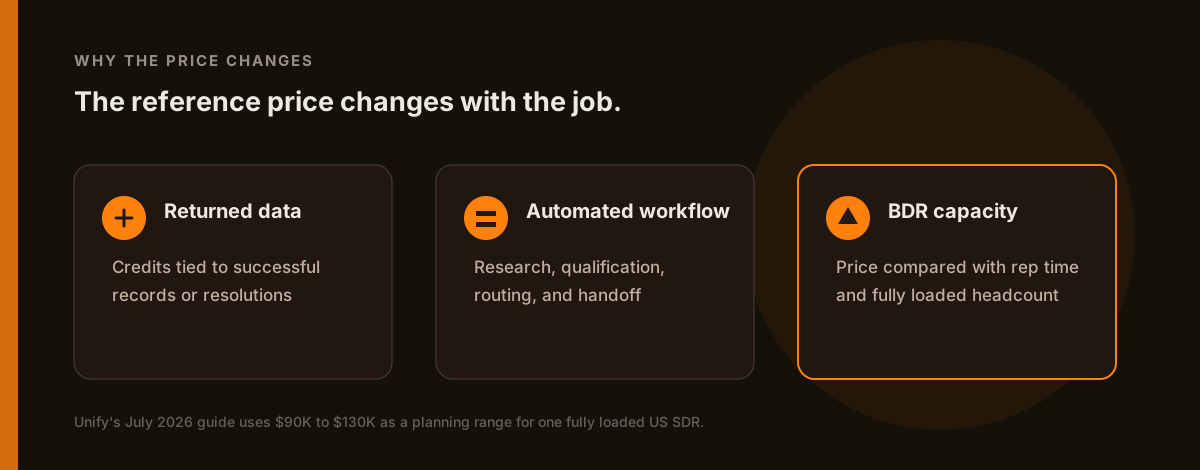
At the action end of the market, the reference price shifts from software to labor. Unify's July 2026 buyer guide compared the cost of AI SDR and human SDR to justify the price. So basically $90,000 to $130,000 per year is a planning range for one fully loaded US SDR, including compensation, benefits, tooling, and management. Unify labels that figure an industry-typical range rather than a single independent study. Against that benchmark, Breakout Growth tier at $24,000 per year and the $30,000 entry points from Warmly and Common Room equal roughly 18% to 33% of one SDR's annual cost.
This cluster suggests a second pricing anchor: the contract buys a fraction of BDR capacity. The claim can be tested against the work that actually disappears:
Annual capacity value = number of reps × automated hours per rep each week × loaded hourly cost × 52
Three reps saving ten hours a week at $50 per loaded hour creates $78,000 in annual capacity. One rep saving three hours creates $7,800. The same $30,000 contract looks very different in those two teams.
Did the products deliver what their websites promised?
We compared the promises and the published outcome from each product's website.
Evidence note: Pricing and business data can change. Every outcome below comes from vendor-published material available by July 31, 2026. Mardex has not independently verified the figures. Individual customer results should not be treated as expected results.
The table exposes a gap between marketing words and published proof. The products commonly promise pipeline, revenue impact, or rep-like capacity. But most of the remaining evidence reports coverage, time saved, response rates, or leads.
Unify is the only product in this sample whose selected case publishes an absolute closed-revenue figure: more than $250,000. Warmly reports a closed-won revenue ROI multiple, without disclosing the revenue amount. No reviewed case documented a holdout or matched control, so none establishes how much of the result was genuinely additional.
So, are AI GTM agents worth the price?
Now let us return to the question. Is it only a marketing hype, or it really worth the investment? I guess the answer depends on which cost already exists. If a team is paying for incomplete contact data and manual research, then enrichment agents can be judged against valid-record cost and hours recovered. If qualified website traffic is going unidentified or unanswered, then visitor agents can be judged against additional qualified conversations and followed up pipelines. If several signals, data providers, and outbound workflows already require people to connect them, then orchestration platforms can earn their higher price through consolidation and recovered BDR capacity. But you have to do the math very carefully.
And if the company has no baseline, little qualified demand, or an unreliable CRM, then the agent has no measurable economic problem to solve.
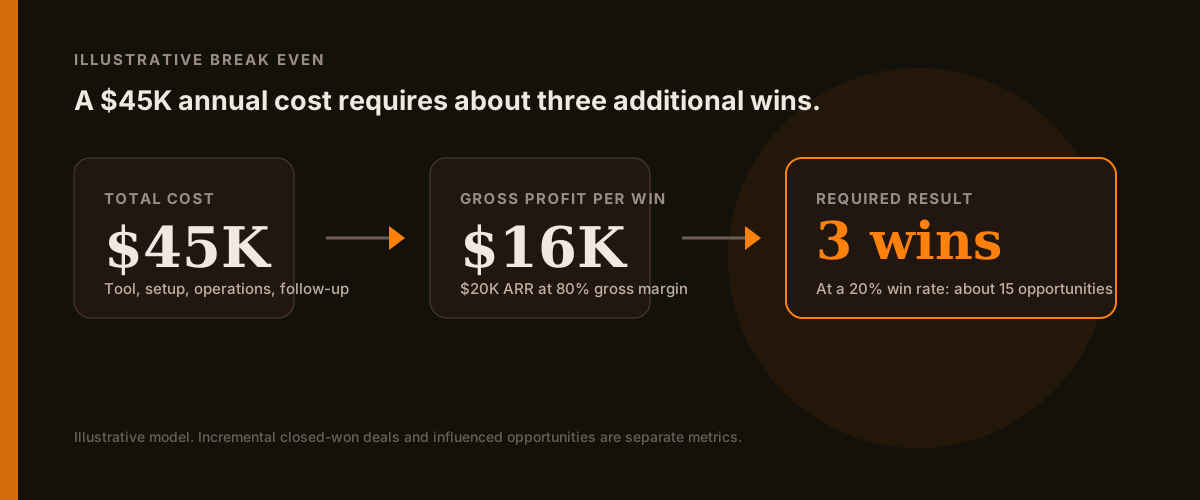
The public evidence supports testing these products against a defined bottleneck. It does not support assuming the vendor's pipeline claim will become incremental revenue for every buyer. The contract becomes defensible when measured capacity savings and additional closed revenue exceed its complete cost.
Use Mardex to compare GTM tools by category and build a shortlist around that bottleneck.