

The Event Marketing Platform Reset: Three Paths After the Virtual Boom
Event marketing software has travelled through a complete market cycle in a few years.
In 2020, it was asked to do something absurdly large, almost overnight: replace the room. A platform had to become the door, stage, lobby, networking floor and help desk. Demand surged. Roadmaps moved at emergency speed. For a while, almost every virtual-event product looked as if it belonged to the future.
Then the doors reopened, and the category split.
Some virtual-event products were folded into larger suites or retired. Webinar tools kept selling a smaller, steady service. Other platforms expanded into planning, onsite work and follow-up.
A feature list will not explain why these companies took different paths. For that, we need to look at what event teams still needed after venues reopened.
The boom made every product look like the same product
During lockdowns, the buying question was brutally simple: can this event happen online?
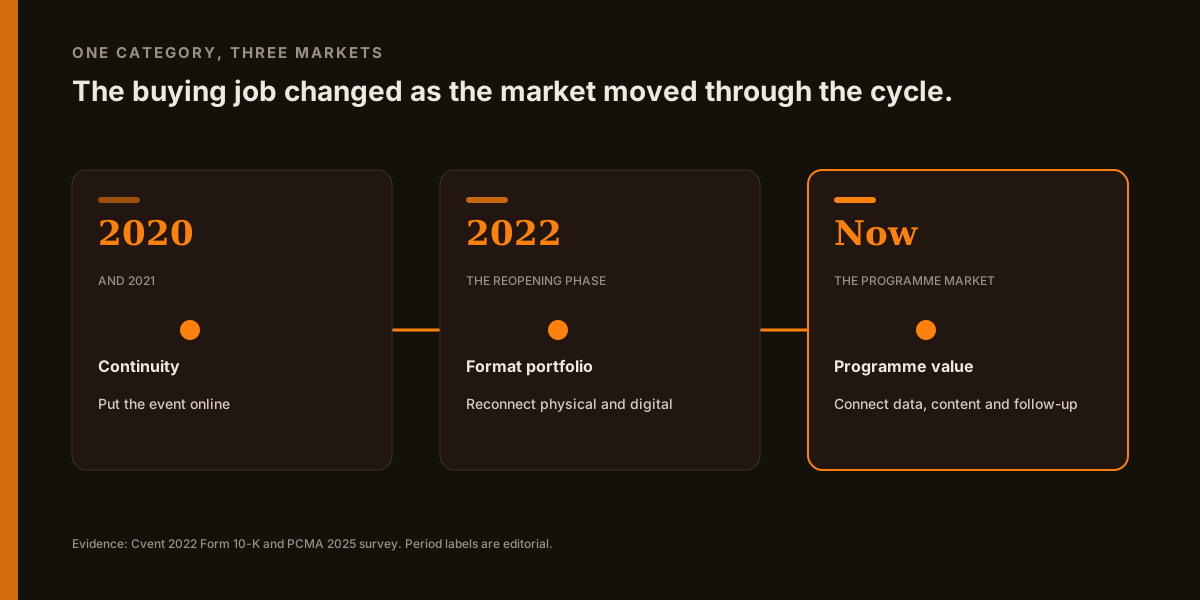
Webinar software, event suites, communications platforms and digital-venue startups all competed for the same emergency budget. Reopening pulled them apart. First came the rush back to rooms; then format experimentation; now the harder question is whether technology makes the whole programme more valuable.
Value, not features, split the market
Once organisers could meet in person again, “we can put your event online” was no longer enough. Some virtual-event products were folded into suites or retired. Webinar tools kept a smaller business. Other platforms took on more of the work around an event. Here is why they went different ways.
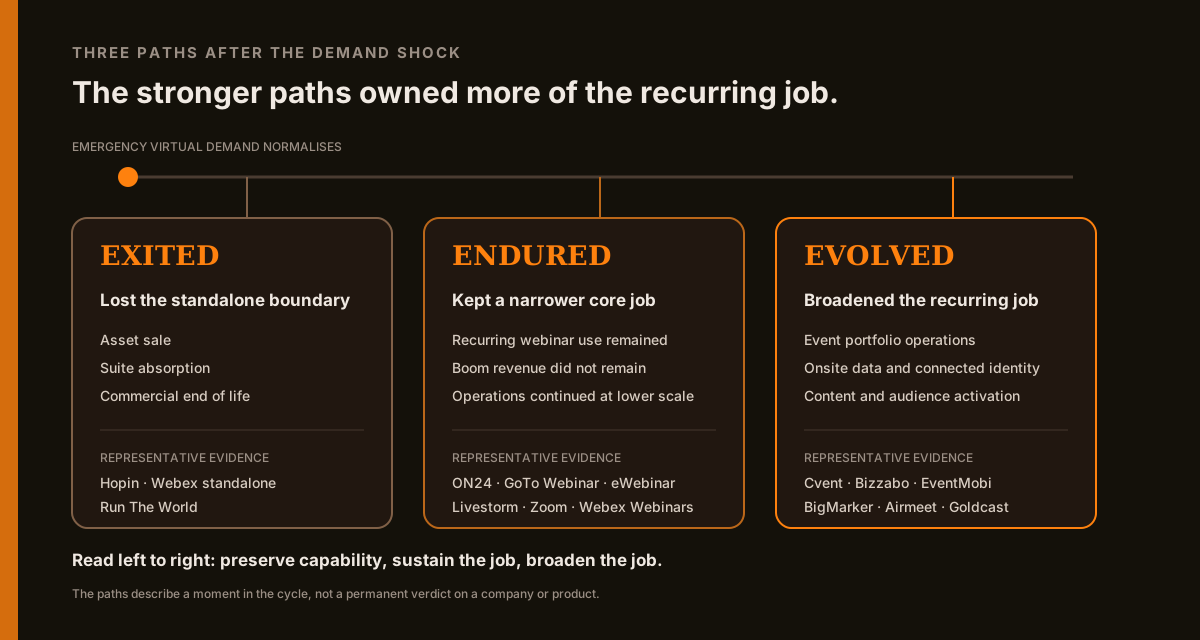
These labels describe what happened to products, not a verdict on their makers. A product can change hands and keep serving customers; a company can add new features without returning to growth.
Exited: Absorbed into a relationship customers already paid for
During lockdowns, a virtual-event platform could make a simple promise: when the venue is closed, we can put the whole event online. That promise justified its own line item, a dedicated tool and vendor relationship. Once venues reopened, the promise stopped being special, and with it went the reason to pay for virtual delivery separately from the communications tools a company already owned.
That pattern runs through three unrelated deals. In August 2023, RingCentral bought Hopin's Events and Session products and folded them into its existing meetings, rooms and webinars line-up, not a new category but a new tab in a suite customers already used; Hopin Events lives on as RingCentral Events. Cisco stopped selling Webex Events Standalone in April 2024 while keeping Webex Webinars inside the suite it always sold. EventMobi bought Run The World in August 2023 to fold virtual capability into a broader offer it already sold to the same customers. None of these buyers needed the acquired product to win on features — they needed it to remove a customer's reason to keep a second vendor relationship.
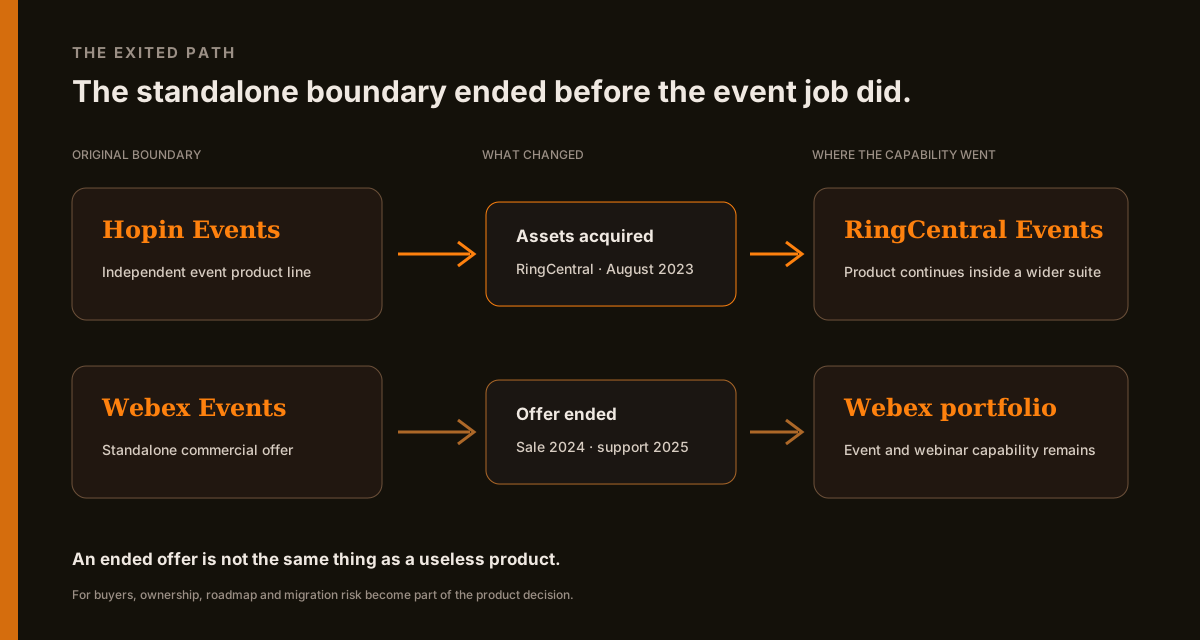
If you use one of the absorbed products, what matters now is who supports it, whether your data and integrations survive the move, and whether the acquirer has a reason to keep investing in it once it is one tab among many.
Endured: A weekly habit outlasted an annual surge
An online conference happens once a year. A product demo, a training session or a customer webinar happens every week. That difference is the whole story of who endured: the pandemic inflated both, but only one was already a permanent line in a marketing team's calendar before 2020.
ON24 makes this case inside a single company. Virtual Conference, the closest thing it sold to a Hopin-style virtual venue, made up only about $2 million of ON24's $124 million in year-end 2025 ARR; the core webinar platform made up the other $122 million, according to its annual report. Same company, same pandemic tailwind: the product built around a habit kept its business, and the product built around a one-time surge nearly disappeared.
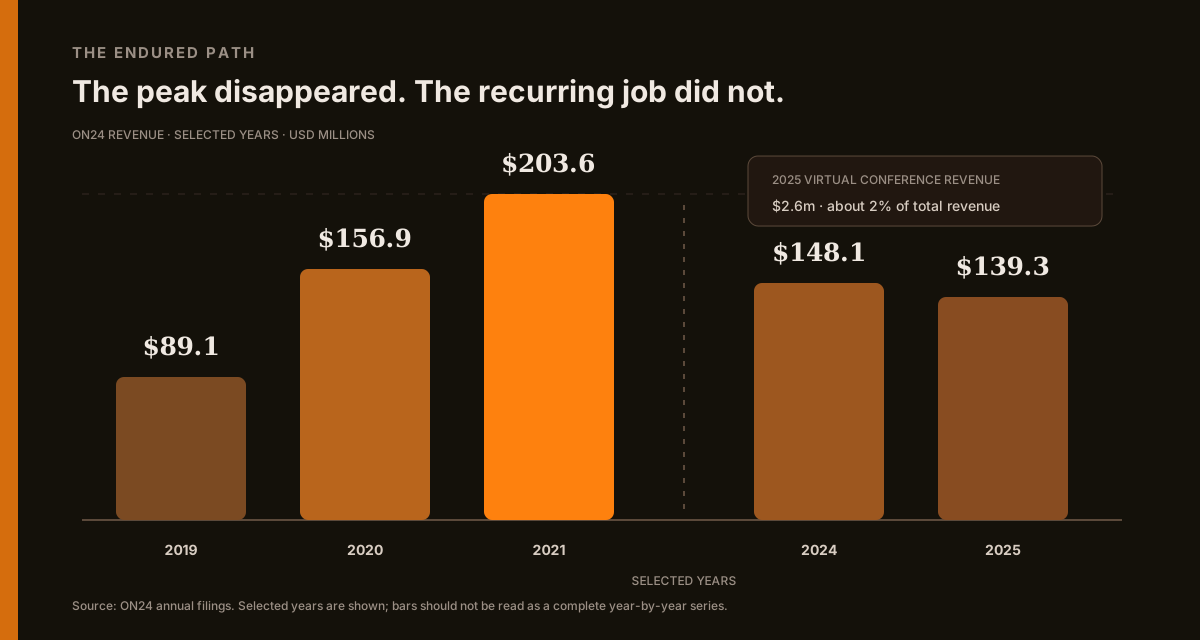
ON24's total revenue climbed from $89.1 million in 2019 to a pandemic peak of $203.6 million in 2021, then fell every year after to $139.3 million in 2025. Its annual recurring revenue, or ARR, the value of subscriptions still running at year-end and a different figure from revenue booked during the year, followed the same arc: $124 million at the end of 2025, down from $129.7 million a year earlier, even with new AI and content features added. Cvent bought the company in April 2026. Enduring did not mean pandemic-era growth returning. It meant staying well above the 2019 baseline while the pandemic-era piece of the business faded.
The same logic explains why GoTo Webinar, eWebinar and Livestorm are still sold as standalone products, and why Zoom and Webex kept webinars inside their suites: a webinar was never a substitute for an event, so its reason to exist was never tied to the pandemic in the first place.
Evolved: A head start and a fast reaction, not the same move
Expanding beyond the livestream, into planning, onsite work and follow-up, is what let some platforms grow instead of just holding on.
Cvent is the head-start story. It sold registration, onsite and venue-sourcing tools before 2020, so when in-person events returned, that existing footprint became more valuable. In 2022, its Event Cloud revenue grew 21.8% and Hospitality Cloud revenue grew 20.9%, according to Cvent's annual report, and Blackstone bought Cvent in June 2023 for an enterprise value of about $4.6 billion. It then kept adding pieces around the event: Prismm for venue design, Cross Event Insights for cross-event reporting, and Goldcast and ON24 for webinars and video, extending a lead it already had.
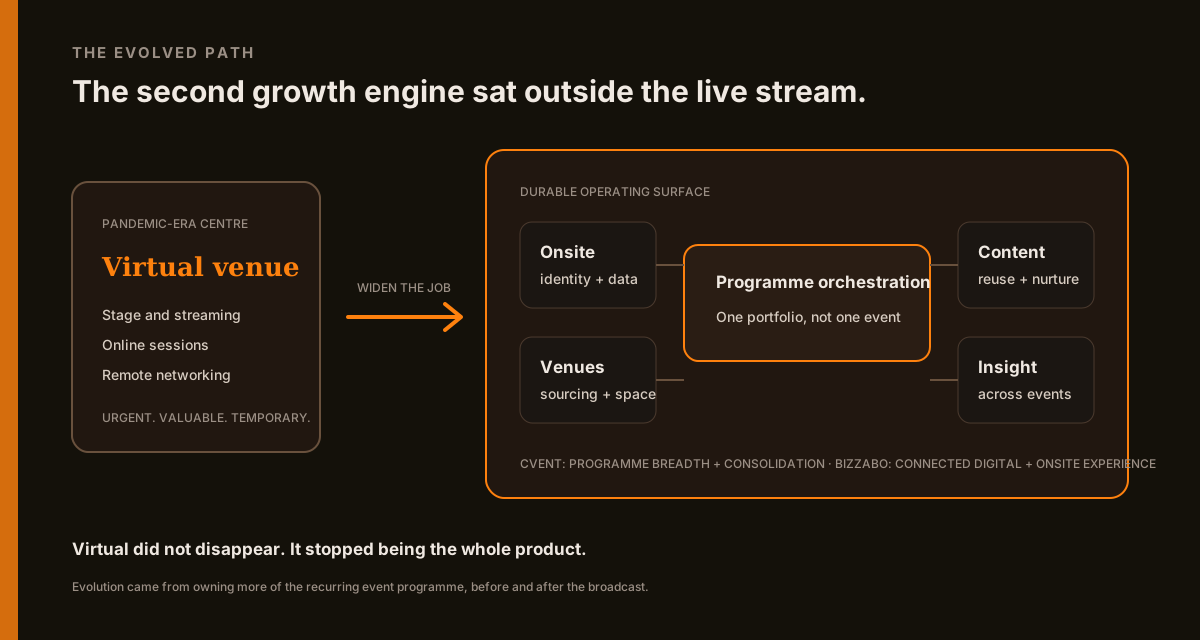
Bizzabo is the fast-reaction story. Its problem only existed once people went back to venues: at an in-person event, valuable conversations happen everywhere, and organisers usually cannot tell who met whom or what interested them. Bizzabo bought Klik in 2021 to capture that onsite data, responding to the return of the room while it was still coming back, not years afterward. By June 2024, Bizzabo said its customers had run 52% more events in the first half of the year than a year earlier, with in-person events up 40.3% and virtual down 0.8% in January–May, customer activity, not confirmed revenue growth, but evidence the problem Bizzabo bet on early was real.
Not every company that tried this expansion pulled it off, and Hopin is why the difference cannot be explained by strategy alone. In June 2021, near the height of a $7.8 billion valuation, Hopin bought Boomset for onsite check-in and badging, the same move into hybrid and in-person work that made Cvent and Bizzabo grow. It did not save Hopin. The company cut 29% of its staff in summer 2022 as in-person events pulled demand away, and by August 2023 it sold its core events business to RingCentral for $15 million upfront, a fraction of the more than $1 billion it had raised. The strategy was not the problem — Hopin expanded into exactly the areas that worked for Cvent and Bizzabo. What it could not undo was a cost structure built for emergency-era demand, a funding market that stopped backing the whole category after 2021, and the multi-year head start Cvent already had in the onsite relationships Hopin was only just acquiring.
EventMobi, Goldcast, BigMarker and Airmeet are all attempting some version of the same move, extending into the work before or after the live session. Their product pages confirm the strategy; they do not confirm which of these privately held companies has turned it into a durable business. The test that separates a real second engine from a longer feature list is the one Cvent and Bizzabo both pass and Hopin did not: does the expansion connect to data and relationships the company already has, or is it a new business bolted onto an old one under pressure?
The event is bigger than the livestream
Imagine someone registers for your webinar, misses it, then visits your booth a month later. Will your team recognise the same person and know what to send next? Or will the two events leave behind two unrelated lists?
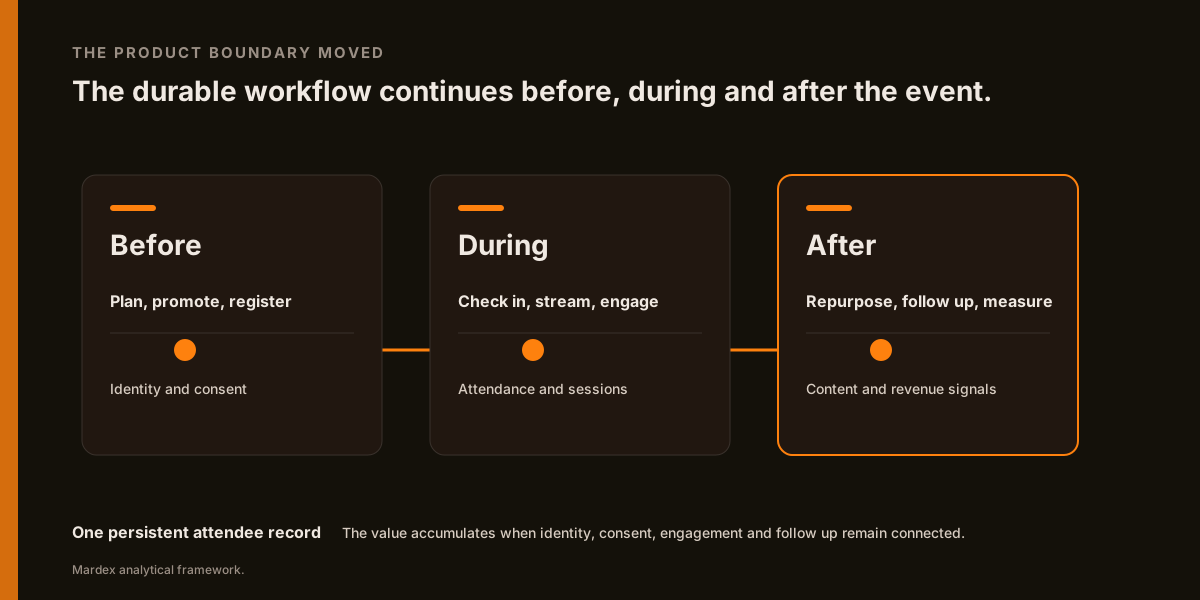
This is why registration, check-in, content and follow-up matter as much as the stream itself. A broad platform is worth paying for when those steps actually connect. If its modules do not share useful data, you may be better off with a specialist that does one important job well.
What the market looks like now
There is no single kind of “event marketing platform” to compare. Some tools manage a whole programme; others handle registration, webinars, onsite work, tickets or the content left behind.
Gartner's 2026 Magic Quadrant for Event Marketing and Management Platforms includes Accelevents, Bizzabo, Cvent, EventMobi, RainFocus, SpotMe, Stova, Swoogo and vFairs. Its scope covers hosted external B2B events, not every product an event team may buy.
Mardex's Event Marketing category is wider. It helps to group tools by the work you would buy them to do.
| Type of tool | Examples | What it helps with |
|---|---|---|
| Event programme platforms | Cvent, Bizzabo and RainFocus | Manage multiple events, teams, data and reporting in one place |
| Registration and event operations | Swoogo, EventMobi, Stova, Accelevents and vFairs | Build event pages, register attendees, check them in and connect other tools |
| Webinars and online events | ON24, GoTo Webinar, eWebinar, Livestorm, RingCentral Events, Zoom Events, Webex Webinars and SpotMe | Host live or on-demand sessions and see how people engaged |
| Onsite and field-event tools | Badging, lead-capture, meeting-booking and routing specialists | Track check-ins, meetings, leads and follow-up at physical events |
| Ticketing and discovery | Eventbrite and other marketplaces | Sell tickets and help people find events |
| Event content and follow-up | Goldcast, BigMarker, Airmeet and adjacent video, community and automation products | Reuse event content and keep engaging people afterwards |
Some products appear to fit more than one row. That is fine. Start with the work your team needs done, then compare the products that can do it.
Eventbrite, for example, helps organisers sell tickets and reach audiences. That is a different business from running enterprise webinars. Eventbrite reported $291.8 million in 2025 revenue, down from $325.1 million in 2024; Bending Spoons bought it in March 2026. It belongs on the map, but its results should not be treated as a verdict on every event platform.
The pandemic made online delivery look like the whole event-tech market. It was not. Rooms came back, webinars stayed on as a smaller and steadier business, and the platforms still growing three years later are the ones that stopped selling a standalone event and wired themselves into demand gen and demand capture instead: registration feeding the pipeline, content feeding the next campaign, one record following a prospect from webinar to booth to deal.