


GEO Tools: How to Track Brand Visibility in AI Search
Open ChatGPT and Perplexity and ask each one for the best tools in your category. Write down the brands mentioned, the descriptions, and the cited sources. Run the same prompts again next week. If the answers change, you have found the measurement problem that GEO tools are trying to solve.
These platforms track whether a brand appears in AI-generated answers across ChatGPT, Perplexity, Google AI Overviews, and similar engines. The category is young, and buyers still need to separate useful monitoring from a dashboard that turns unstable answers into false precision.
What GEO tools do
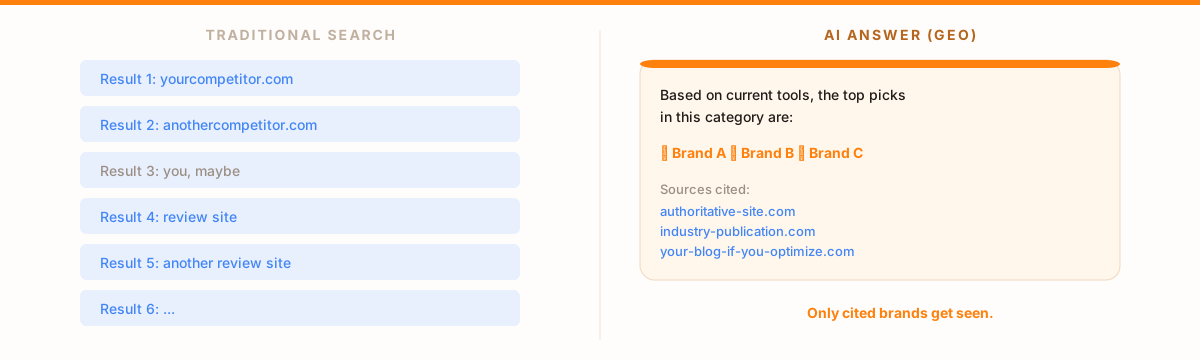
Generative engine optimization (GEO) tools track brand mentions and citations across AI search engines at scale and over time. The core functions:
Brand mention monitoring. The platform queries AI engines regularly with keyword sets relevant to your category and tracks when your brand is mentioned, how it is described, and which competitors appear alongside or instead of you.
Citation source analysis. Most tools also identify which sources AI engines are drawing from when they cite brands. This tells you which publications and content types carry weight with the models, and therefore where it is worth investing in earned media.
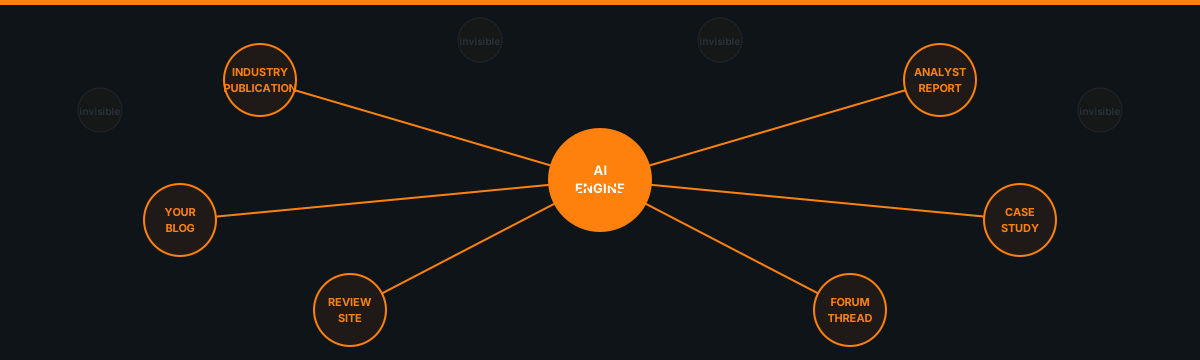
Competitor share of voice. You can see which competitors are cited more frequently than you in your key queries, and how that shifts over time as you execute your GEO strategy.
Query and category coverage. Better tools let you define both branded searches and category queries such as "best [category] tool for [audience]." Branded prompts show how existing awareness appears in AI answers. Category prompts show whether the brand enters the consideration set for buyers who do not know it yet.
The tool landscape right now
This is an early-stage category, so the options range from purpose-built enterprise platforms to lightweight monitoring tools.
Profound is one of the better-funded platforms in the category and is built for teams ready to invest. It tracks brand presence across multiple AI engines, including ChatGPT, Claude, Perplexity, Google AI Overviews, and Gemini. Fortune reported a $96M round in early 2026 after earlier funding rounds. That proves investor interest. Buyers still need to evaluate coverage, sampling, and whether the output changes a content or distribution decision.
Otterly, Peec AI, and Scrunch AI are lighter options to compare. Otterly focuses on accessible monitoring, Peec AI goes deeper into source analysis, and Scrunch AI combines monitoring with auditing and content workflows. Check their current prices and engine coverage during the shortlist. A solo marketer can begin with a manual audit before committing to ongoing tracking.
Manual tracking, meaning running your key queries in ChatGPT and Perplexity monthly and noting which brands get cited, is free, time-consuming at scale, and surprisingly informative as a starting point.
What to look for when evaluating
Which AI engines it covers. ChatGPT, Perplexity, Google AI Overviews, Claude, Copilot, and Gemini produce different answers and citation patterns. Match coverage to the engines your buyers actually use.
Sampling method. Ask how many prompt variations the tool runs, which locations and languages it covers, and whether it records the model and date behind each answer. A single prompt repeated at scale can create a very tidy picture of a narrow sample.
Update frequency. AI search results change as models update. Tools that query engines daily or weekly give you much more useful trend data than monthly snapshots.
Historical data. If a tool is new, it may not have historical baseline data for your brand, which makes it hard to measure improvement. Ask how far back their data goes.
Source attribution quality. Does the tool preserve the cited source and the answer around it, or only count the mention? Source analysis should give the team a trail to investigate, rather than pretending to prove why a model chose one source.
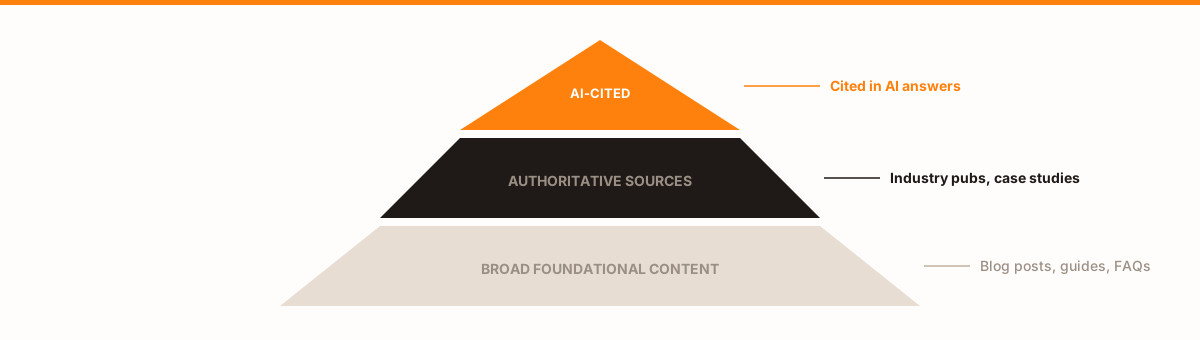
These tools measure visibility. They cannot create authority for you. Citation-worthy content sits at the top of a pyramid built on primary sources and demonstrated expertise, and the dashboard only shows whether that work is appearing in the sampled answers.
What the measurement can tell you
A useful GEO report can show that one competitor appears more often for a defined prompt set, that certain publications recur as cited sources, or that a product is described inaccurately. Each finding leads to a different action: investigate the competitor's cited coverage, strengthen the source material models already use, or correct the public pages that describe the product.
The report cannot prove that an AI mention caused pipeline, and it cannot tell you that every buyer saw the same answer. Model versions, location, language, account state, and prompt wording can all change the output. Treat visibility as a sampled signal. Connect it to referral traffic, branded search, assisted conversions, and sales-call evidence before assigning commercial value.
When it makes sense to buy
GEO tools are worth the investment when AI search is a meaningful part of how your target buyers discover tools in your category. A quick proxy: search your category in ChatGPT and Perplexity and see what comes up. If AI engines are actively recommending specific tools and your brand is not among them, that is a gap worth measuring and closing.
Manual quarterly checks are probably enough while AI search drives little meaningful discovery in your category. Set a reminder to repeat the audit because the category is moving fast.
Browse GEO and SEO tools on Mardex
The SEO and GEO category on Mardex covers both traditional SEO platforms and the emerging AI visibility tools side by side. Filter by capability, pricing tier, or company stage to find what fits where you are.
If your interest is broader content discoverability, such as publishing, content optimization, and distribution, content marketing tools on Mardex covers the adjacent stack. And the SEO research tools that feed a GEO strategy show up in the tools I actually use.