
Which AI Marketing Agents Work in 2026? A Field Guide
Every third software demo now has the same magic trick. The rep clicks a button, the product "understands" the account, writes the follow-up, updates the CRM, and somehow gives you back Friday afternoon.
Lovely. I would also like Friday afternoon back.
The word "agent" is now too broad to help you buy anything. Salesforce, HubSpot, Intercom, Klaviyo, Canva, Notion, and a long tail of startups all use it. One agent summarizes CRM data. Another drafts a campaign. Another talks to customers while a usage meter runs in the background. Another sends cold email at scale, which is where I start clutching my imaginary legal budget.
The useful buying questions are: where does the agent work, what can it touch, what does it cost when it succeeds, and what happens when it is wrong?
I read the product pages, Reddit threads, G2 and Capterra reviews, pricing complaints, teardown videos, and the quieter places where practitioners talk after the sales call is over. This is the field report.
First, judge the job behind the agent label
Before judging individual tools, start with the market-level warning. Gartner estimates that of the thousands of vendors now advertising agentic AI, only around 130 actually offer it. The rest fall into what Gartner analysts call agent washing: an old chatbot, workflow builder, or automation script receives a new label and a more ambitious price tag. Gartner also expects more than 40% of agentic AI projects to be canceled by the end of 2027, partly because the gap between demo and production is still painfully wide.
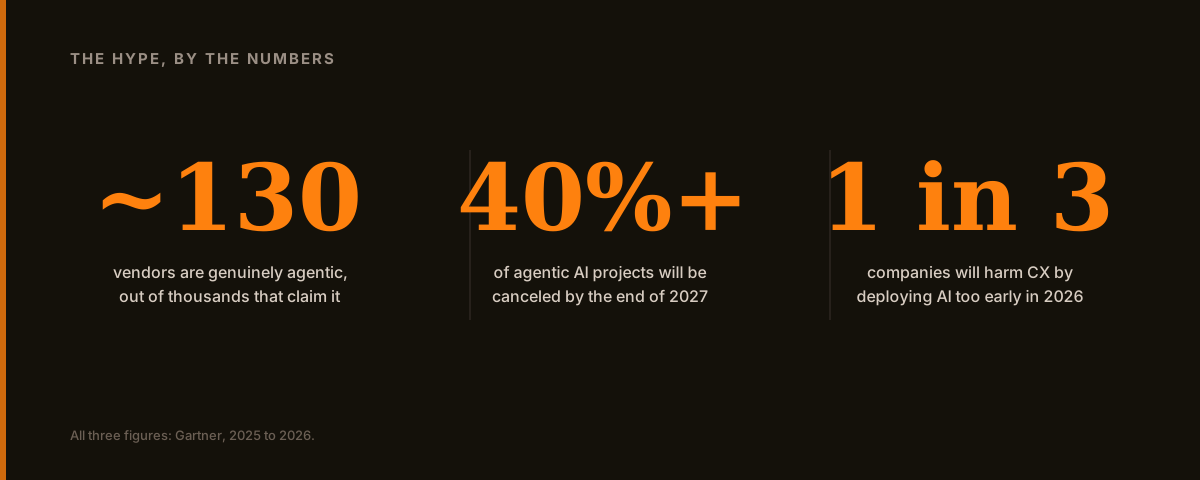
That is the market backdrop for every vendor comparison in 2026. The label is noisy, the demos are polished, and the production gap is still real.
After that first filter, the second mistake is treating a broad platform as one thing. HubSpot Breeze and Salesforce Agentforce are useful examples because each is a platform layer. One name can cover CRM research, meeting prep, content drafts, lead qualification, customer support, and sales follow-up.
HubSpot describes Breeze as AI across the whole customer platform: prospecting, customer support, content, CRM data, meeting prep, enrichment, and more. Salesforce describes Agentforce as an enterprise agentic platform for customers and employees, with use cases including customer service, sales development, employee support, deep research, product recommendations, events, and scheduling. Salesforce has also made Agentforce a financial reporting line: in its May 27, 2026 earnings release for the quarter ended April 30, 2026, the company said Agentforce ARR reached $1.2 billion, up 205% year over year.
Those jobs need separate verdicts. A Breeze CRM research task and a Breeze support bot carry different risks. An Agentforce internal research workflow and an Agentforce case-resolution workflow deserve different checklists. The deployment is the unit of analysis: use case, permissions, data quality, review path, and pricing meter.
The same standard applies to smaller products. The agent badge is only the first claim. Ask which agent or subagent does the work, what data it can see, what action it can take, and what problem disappears if it works.
The buyer test I would use:
- What exact job disappears from the team calendar?
- What data does the agent use, and is that data already clean enough to trust?
- What can the agent do without human approval?
- What pricing meter moves when the agent succeeds?
- What happens when the agent is wrong?
If the vendor cannot answer those five questions without sliding back into demo theater, I would keep the credit card in my pocket.
Use first: internal agents with narrow permissions
The safest agent work in 2026 is internal, bounded, and grounded in data the system already owns.
Think CRM research, meeting prep, account summaries, record enrichment, workflow handoffs, and internal knowledge questions. The agent can still be wrong, but the blast radius is smaller. A marketer can review the output before it reaches a prospect or customer.
This is where platform agents can make sense, as long as the job stays narrow. Breeze CRM research is a good example. On r/hubspot, users describe giving Breeze real CRM questions, such as comparing this year's closed-won deals with last year's to see whether the ICP had shifted. That is a concrete job, inside data HubSpot already has, with a human still reading the answer.
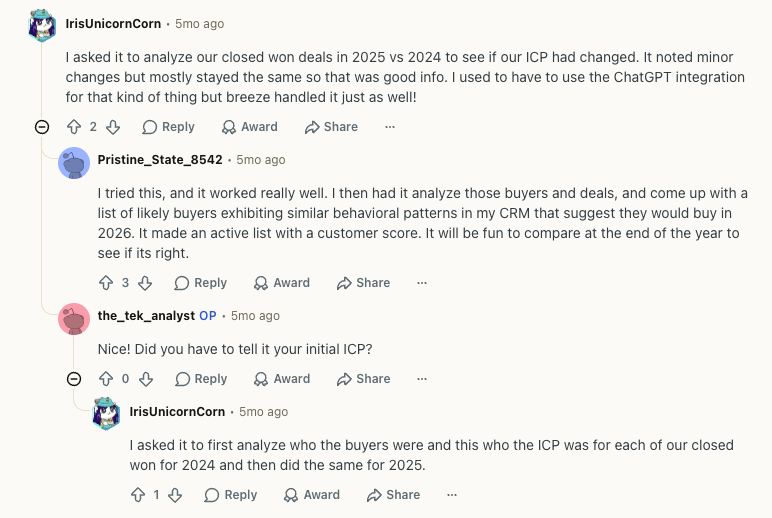
A useful review tells you the job, the data source, and the old workaround it replaced. That is the level of specificity I would look for before trusting any agent claim.
Agentforce can fit the same pattern when the deployment is internal. Salesforce lists "Deep Research" and employee support as Agentforce use cases, which are much closer to internal productivity than front-line customer automation. If Agentforce is processing internal account data, preparing a rep, or answering employee questions behind a review step, I would evaluate it the same way I evaluate Breeze: data quality first, permissions second, output review third.
That narrow yes does not extend to every feature in the platform. An internal, reviewed workflow has a different risk profile from an agent that talks to customers or changes records on its own.
The same logic applies beyond the big suites. Cassidy grounds agents in internal documents. Gumloop and Lindy let marketers build workflow agents across apps without engineering help. Relevance AI focuses on GTM research and qualification agents. I would give one of these tools a single annoying job, then measure whether that job actually disappeared from the team's calendar.
For the broader operating model, I went deeper on this in the agent management piece. The short version: agents become useful when someone designs the system around them. They become expensive toys when the system is missing.
Drafting agents: useful within a narrow scope
The next tier is less dangerous and less exciting: content and campaign drafting. Klaviyo can help build flows. Jasper has rebuilt around marketing agents. HubSpot says Breeze can turn content into emails, social posts, and blogs in your brand voice. On a blank page day, that is helpful. I am not above being grateful for a decent first draft.
The ceiling is also obvious. The output gets generic as soon as the subject is technical, the market is narrow, or the brand voice has real edges. Reviews of Breeze's marketing features land in that familiar place: useful for standard content, still in need of serious editing when the work needs judgment.
I would use these agents when they come with a tool I already own. A drafting assistant can save time, although it rarely changes the economics of a marketing team by itself. The brief, positioning, proof, and human review still determine whether the draft becomes useful work.
Use carefully: agents that talk or act for you
Now the stakes change. A weak email draft costs editing time. A weak support answer can become a broken promise. A weak sales development agent can book the wrong meeting, mishandle an objection, or send something your brand would never say out loud.
This section is about a deployment pattern, not a vendor. The moment an agent answers a customer, books a meeting, resolves a ticket, qualifies a lead, or changes an order, the review model has to get stricter.
The riskiest version is the support or sales agent with a thin view of the customer. It can read help-center articles, but it cannot see the contract, plan, entitlement, renewal history, open tickets, implementation context, or CRM notes that a human would check before answering. That is how a fluent answer becomes a wrong promise.
A platform agent only enters this zone when it is configured for outward-facing work. More focused tools like Intercom Fin live here by design. The vendor name matters less than the question: does the agent have the right knowledge, and what is it allowed to do before a human sees it?
The Agentforce review below is useful evidence because it comes from a serious platform rather than a flimsy chatbot wrapper. The praise is real: people like that an operations team can build an agent without code. The caution shows up when users talk about launch reality.
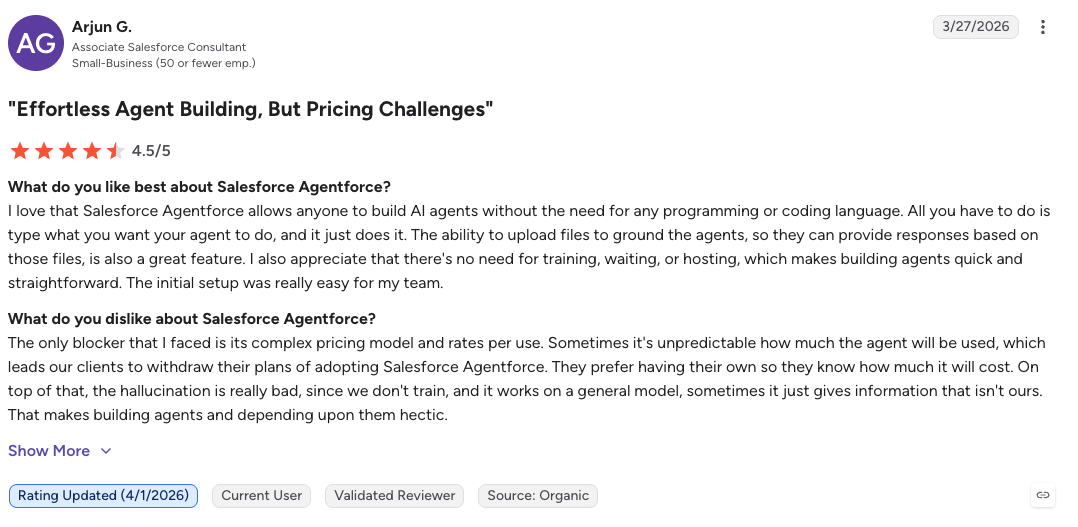
Read the actual complaint and the tradeoff is obvious. The builder is easy. The bill can be hard to forecast. The agent can also say things that are not in the company's own information. For internal research, that is annoying. For a customer conversation, it is dangerous. That distinction is why I would not use one verdict for the whole product.
Intercom's Fin has a cleaner product focus, but the buyer problem is similar. It can resolve a real share of support tickets, which is exactly why teams buy it. The complaint is the resolution meter. Fin has been priced at $0.99 per resolution, and users object when the definition of "resolution" does not match their own view of whether the customer was actually helped.
This is where agent evaluation has to get very literal, for whichever vendor is in the room. Do not ask only for the resolution rate. Ask what counted as a resolution. Ask what was escalated. Ask what was wrong. Ask who reviewed the wrong answers. Ask what happens to the bill if the agent gets popular.
Public failures make the point painfully concrete. Retail and support chatbots have given customers wrong policy answers, and companies often have to choose between honoring the bad answer or creating an even angrier customer. That is why I would turn these agents on only with a clean knowledge base, limited permissions, visible escalation paths, and a human handoff that works before the customer starts shouting.
If pricing games are already the worry, start with the renewal playbook. Agents add a new meter to a problem SaaS buyers already know too well.
Avoid for now: AI SDRs and agent washing
Two buckets still look like trouble.
The first is the AI SDR category: agents that send cold outreach at scale. Artisan's Ava became the famous example after the "Stop Hiring Humans" billboards. The marketing got attention. The operating risk is more important. When the message quality drops, inbox placement can collapse, with one account reporting a fall from 92 to 71 percent. Team accounts have also been restricted or banned for spam. User reviews include a Reddit account of roughly 1,400 emails sent with zero replies.
Cold outreach is already a trust tax. Automating more of it with weaker judgment can burn the asset you cannot buy back quickly: domain reputation. I would be extremely slow here unless the tool gives you tight control over targeting, copy, send volume, deliverability, and human approval.
The second bucket is agent washing you can feel as a user. Notion is the clean example: a workspace people loved that suddenly pushed AI into more corners of the product.
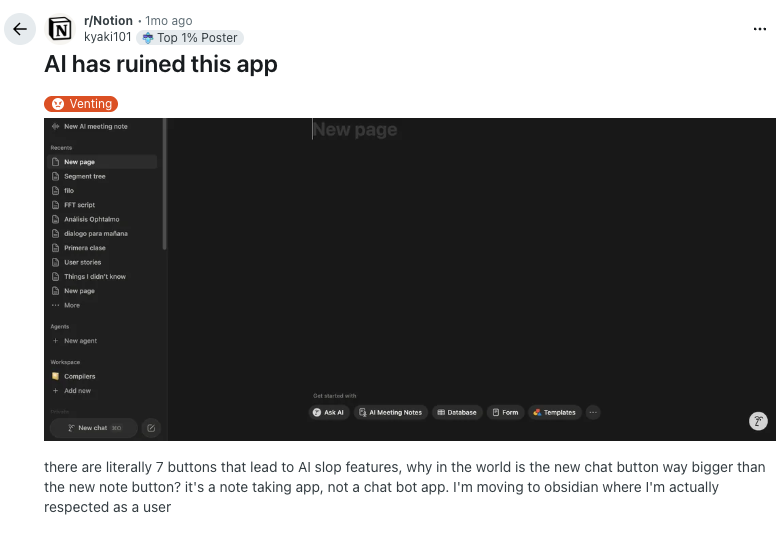
The complaint is about clutter rather than AI itself. Power users are saying the feature adds surfaces, buttons, and cognitive load without removing enough work.
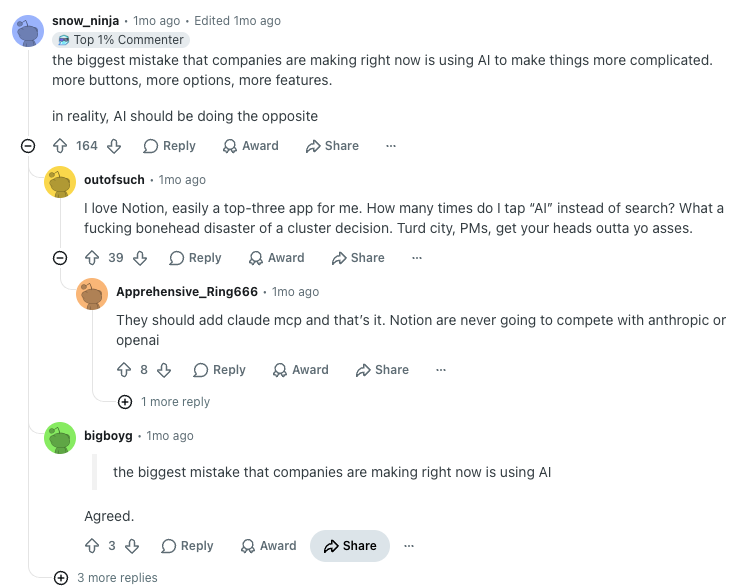
That is the buyer signal. If the agent adds a button and a bigger bill, then leaves the same work on your plate, you are funding a roadmap story. A real agent should make at least one workflow visibly lighter.
The 2026 verdict
My sorting rule is blunt:
- Turn on internal agents that work inside data you already trust.
- Treat content agents as drafting support, especially when they are already included.
- Put customer-facing and action-taking agents behind strict guardrails.
- Avoid autonomous cold outreach and agent washing until the evidence gets much better.
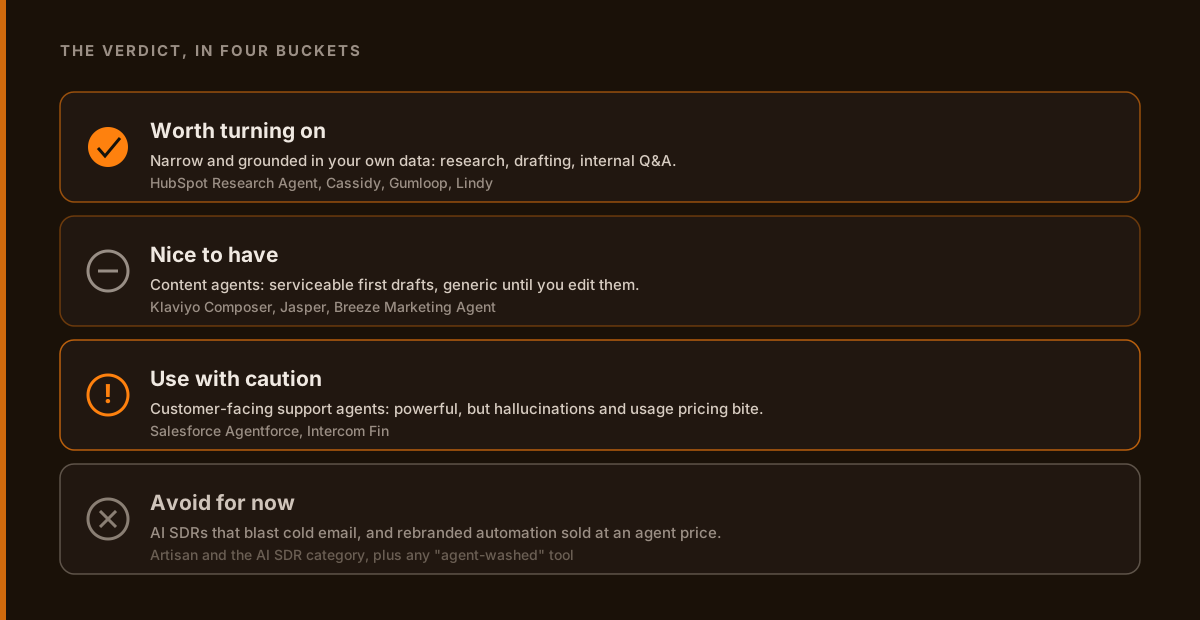
The common thread is control. A useful agent has a bounded job, a trusted data source, a clear permission model, a pricing meter you can forecast, and a fallback when it fails. That sounds less exciting than the launch video. Good. Excitement is what vendors sell before implementation gets hard.
If I were buying today, I would start with one agent, one workflow, and one success metric. Let Breeze or Agentforce answer a specific internal CRM question. Let a workflow agent enrich one kind of lead record. Let a content agent draft one repeatable email type. Then check the boring evidence: did the work disappear, did quality hold, did the bill make sense, and would the team choose to keep it after the novelty wore off?
The workflow is the agent test I trust right now. A product earns the label when one bounded job disappears, quality holds, the bill is predictable, and the team keeps using it after the novelty wears off.