


How to Choose a Marketing Attribution Tool in 2026
Attribution tools are one of the most expensive categories in the martech stack, and also one of the most over-purchased. Before you evaluate vendors, the most useful question is whether you actually need a dedicated attribution platform, or whether what you have already is sufficient.
Start with the decision you need the data to support. GA4 is often enough when the journey is short, the channel mix is simple, and the team mainly needs to understand which sources produce direct conversions. A dedicated platform starts to earn its cost when several ad platforms claim the same revenue, the journey crosses sales and marketing systems, offline touches matter, or finance needs one reconciled view of performance.
What attribution tools actually do
Attribution platforms sit on top of your ad accounts, analytics, and CRM data and try to answer one question: which marketing touchpoints drove this conversion, and in what proportion?
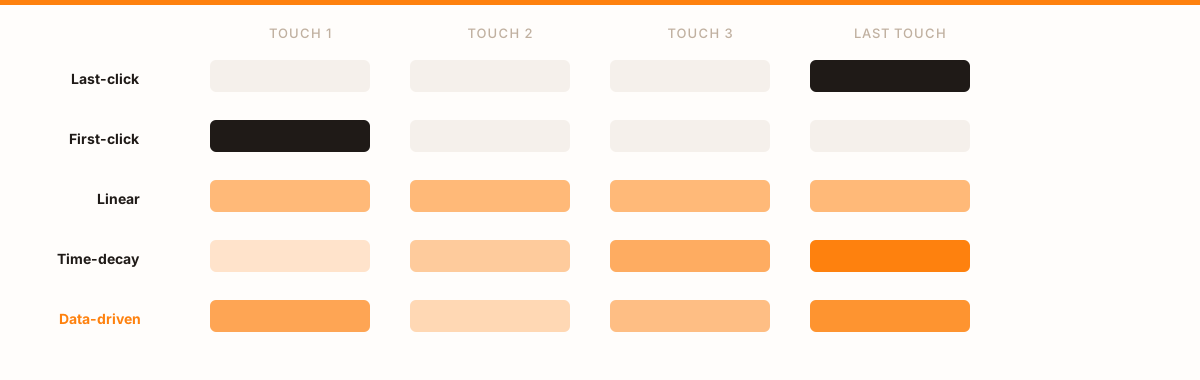
The answer varies depending on the attribution model the tool uses. The main ones:
Last-click gives all credit to the final touchpoint before conversion. The default in most ad platforms. Systematically overstates the value of bottom-of-funnel channels like branded search and retargeting.
First-click gives all credit to the first touchpoint. Useful for understanding acquisition channels; useless for understanding what closes deals.
Linear splits credit equally across every touchpoint. Fairer than single-touch, but treats a banner impression the same as a 30-minute demo.
Time-decay weights recent touchpoints more heavily. A reasonable approximation for short sales cycles.
Data-driven / algorithmic uses your conversion data to assign credit based on statistical relationships. Its reliability depends on conversion volume, tracking quality, and how stable the underlying customer journey is. Ask the vendor what minimum volume its model needs and what happens when your data falls below it.
The three tool types and when each makes sense
Channel-level attribution dashboards (e.g. Rockerbox, Northbeam, Triple Whale for e-commerce) pull data from all your ad platforms and show you cross-channel performance in one place with consistent attribution logic. Best for e-commerce and DTC brands spending heavily across Meta, Google, and TikTok who need a single source of truth across platforms that each claim full credit for every sale.
Multi-touch attribution platforms (e.g. Bizible/Marketo Measure, Attribution) map every touchpoint across the full buyer journey to revenue. Best for B2B companies with long sales cycles and a CRM as the revenue source of truth. These integrate deeply with Salesforce or HubSpot and show which campaigns influenced pipeline and closed revenue.
Marketing mix modelling (MMM) tools (e.g. Meridian, Robyn) use aggregated channel and outcome data rather than user-level paths. This reduces their reliance on cookies and lets them model offline channels. They also need enough variation in spend and outcomes to estimate an effect, plus statistical expertise to keep a neat-looking model from producing a bad budget decision.
Two buying cases
Consider an e-commerce team running Meta, Google, TikTok, affiliates, and email. It has thousands of monthly orders, and each ad platform reports a different version of revenue. A channel-level attribution platform can give that team one consistent set of rules for comparing paid media. The decision it improves is frequent and expensive: where next week's budget should move.
Now consider a B2B company with a six-month sales cycle and a small number of closed deals each quarter. A multi-touch platform can connect campaign activity to CRM opportunities, but a detailed model may create more precision than the sample can support. The first job is to make campaign, contact, account, opportunity, and revenue data join cleanly. The attribution layer becomes useful after that foundation is trustworthy.
The difference is the decision frequency, the amount of observable data, and the cost of getting the answer wrong. Media spend alone cannot make the choice for you.
What to evaluate before buying
Data connectors. The platform needs to connect to every channel you actually use. Check the connector list before a demo, since some tools have gaps in less common platforms.
Attribution window flexibility. Can you adjust lookback windows per channel? A paid social click and a display impression should not have the same attribution window.
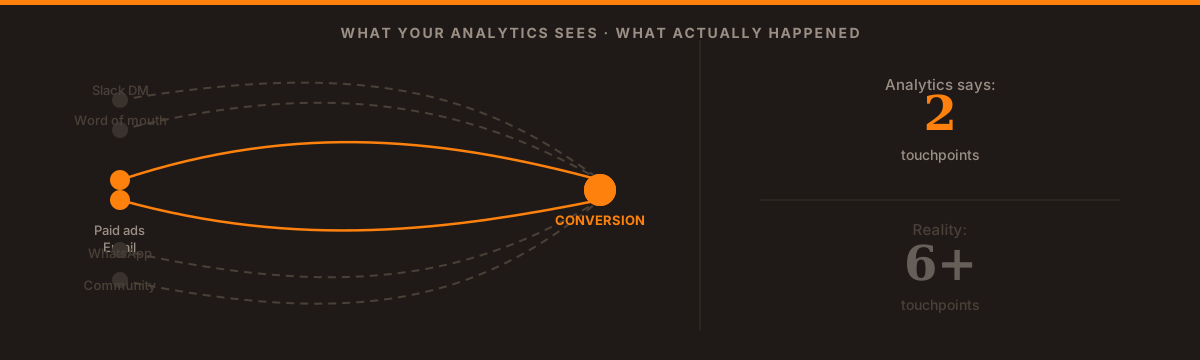
How it handles privacy changes. iOS 14+ and the deprecation of third-party cookies have broken many attribution approaches. Ask specifically how the tool handles modelled conversions and what its accuracy claim is based on.
Implementation complexity. Most enterprise attribution tools require a meaningful implementation project. Get a realistic timeline from the vendor and ask for a reference from a customer with a similar tech stack.
Reporting outputs. Does it produce reports your media buyers and finance team will actually use, or does it create a second analytics layer that nobody trusts?
Before you shortlist a vendor, write down the budget decision the tool should change, the systems it must reconcile, and the person who will trust its output. If those three answers are vague, fix the measurement design before adding another attribution layer.
Price the implementation with the software
Attribution products are rarely a clean plug-in. Someone has to standardize campaign names, connect ad accounts, map CRM objects, resolve duplicate identities, decide how offline touches enter the model, and document which report finance should use. A polished dashboard can hide all of that work during a demo.
Ask the vendor for an implementation plan built around your actual stack. The plan should name the connectors, data owners, historical backfill, validation process, and the first decision the model will support. Then price the internal hours alongside the subscription. If the team cannot maintain the inputs, model sophistication becomes an expensive way to automate distrust.
Find and compare attribution tools on Mardex
The marketing analytics and attribution category on Mardex covers the full spectrum from free GA4 extensions to enterprise MMM platforms. Filter by use case, pricing, or channel coverage to shortlist candidates.
If you are also evaluating the broader measurement stack, marketing operations tools on Mardex cover the data infrastructure layer (CDPs, data warehouses, and tracking tools) that attribution platforms sit on top of.
The right attribution tool should make one recurring decision more reliable. If the team cannot name that decision, the new dashboard will probably become another place to argue about whose number is correct.