
The CRM Market Has Been Rewritten. How to Navigate the New Landscape?
For years, CRM was one of the easiest software categories to understand.
The products varied in complexity and price, but the basic model was familiar. Companies stored accounts, contacts, opportunities, and sales activities in one system. Salesforce built an enormous business around that model. HubSpot later expanded it by connecting marketing, sales, and service around the same customer lifecycle.
That definition has become much less useful.
Today, Salesforce, HubSpot, Klaviyo, Attio, and Braze can all reasonably appear in a conversation about customer relationship technology, even though they solve very different problems. Tools such as Clay, Gong, and Apollo take over customer workflows that once sat inside CRM without necessarily positioning themselves as CRM products at all.
AI is also accelerating the change, but it is only part of the story. Customer data has become richer, business models have become more varied, software pricing is changing, and companies expect CRM to do much more than maintain a database.
CRM is increasingly becoming a collection of different architectures for managing customer relationships. That makes the market harder to compare. It also gives companies more room to choose a system that actually fits how their business works.
The CRM market now contains several architectures
Traditional CRM grew around an account-centric sales model.
A company had an account. An account had contacts. Salespeople created opportunities, moved them through stages, and recorded what happened along the way.
That model still works extremely well for many B2B organizations. It explains why Salesforce remains deeply embedded in large enterprises and why Microsoft Dynamics 365 continues to be attractive where CRM needs to connect with a broader Microsoft and ERP environment.
However, more businesses now operate differently.
A consumer brand may have several million customers and almost no direct human interaction with most of them. Its customer relationship is expressed through browsing behavior, product preferences, cart activity, purchases, email engagement, and repeat orders.
For that company, the useful customer model looks closer to:
Profile → event → product → order → repeat purchase
Klaviyo grew from exactly this environment. It started with lifecycle marketing and commerce data, then expanded across customer data, analytics, messaging, and service. The company now explicitly describes itself as a B2C CRM platform.
A PLG SaaS company can have another structure entirely. It may need to connect individual users, workspaces, companies, subscriptions, product usage, and sales opportunities. A venture capital firm may care more about relationships between people, companies, funds, and deals than a traditional sales funnel.
This is where newer products such as Attio become interesting. Their appeal comes from flexible relationship models, automatic context capture, and lower dependence on manual CRM administration.
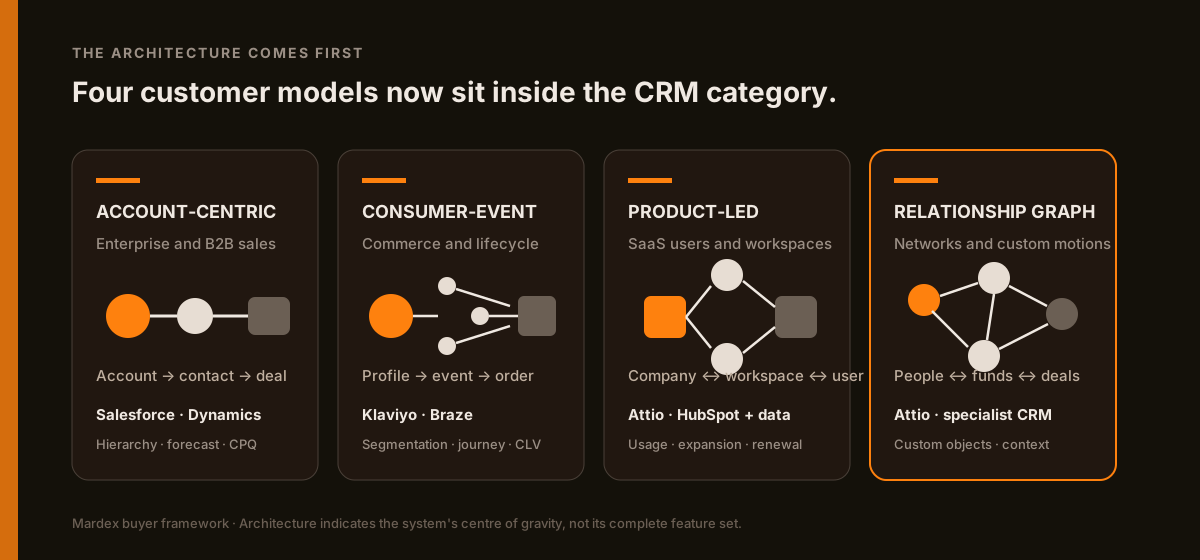
The word CRM now covers systems built around very different assumptions about what a customer is and how a relationship develops.
The financials tell different stories
The financial performance of CRM companies makes this shift easier to see.
Salesforce finished fiscal 2026 with roughly $41.5 billion in revenue and 10% annual growth. At this size, Salesforce is already a mature software platform. The more revealing number is where its new growth story is forming.
Agentforce and Data 360 ARR approached $3.9 billion in its latest reported quarter, while Agentforce ARR alone passed $1.5 billion and was growing at more than 240% year over year.
Salesforce is increasingly monetising customer data, AI infrastructure, and machine-executed work alongside traditional software seats.
HubSpot is widening an integrated customer platform. Full-year 2025 revenue reached $3.13 billion, up 19%, and the company ended the year with 288,706 customers. Its full-year net revenue retention was 103.5%. By June 2026, the customer count had grown to 306,446.
Those figures show that HubSpot continues to be extremely effective at attracting new SMB and mid-market customers into a broad platform that combines marketing, sales, service, content, and automation. Its strength comes from reducing the operational friction of running several GTM functions across separate systems.
Klaviyo and Braze represent a third pattern.
Klaviyo revenue reached roughly $1.23 billion in 2025, growing 32%. Net revenue retention was around 110%, while customers generating more than $50,000 in ARR were growing considerably faster than the overall customer base.
This is the trajectory of a specialist moving outward. Klaviyo won an important workflow, accumulated valuable customer data around it, added more channels and capabilities, and increasingly moved upmarket.
Braze shows a similar pattern in large-scale consumer engagement. Its fiscal 2026 revenue grew more than 24%, with dollar-based net retention around 109%.
Meanwhile, private companies such as Attio offer another signal. Attio does not publish public revenue figures, but its $52 million Series B in 2025 brought total funding to $116 million. Investors are clearly willing to fund a different CRM architecture built around flexible data, automated context, and AI from the beginning.
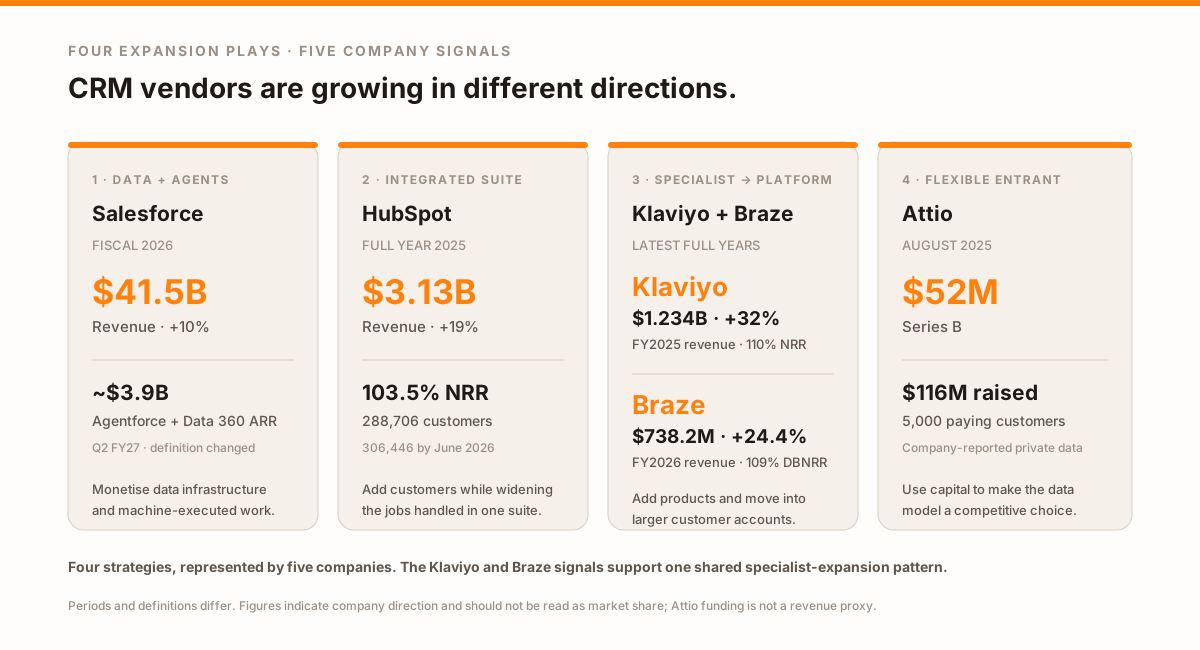
Taken together, these numbers describe a market moving in several directions at once. Large platforms are adding data and agents. Integrated suites continue winning companies that want one GTM operating environment. Specialists are growing into broader customer platforms. AI-native entrants are questioning how much traditional CRM administration should exist in the first place.
AI is changing the CRM bill too
The product model is changing, and the commercial model is following it.
For a long time, CRM pricing was relatively easy to understand. A company bought a certain number of seats at a monthly or annual price.
That model still exists, but it is increasingly only one part of the bill.
HubSpot can charge around marketing contacts and platform usage. Klaviyo pricing is influenced by active profiles and messaging volume. Enterprise platforms increasingly charge for data consumption. AI introduces credits, agent actions, and other usage-based units.
Salesforce now even reports Agentic Work Units, a measure of work performed through its agent infrastructure. This is a meaningful shift in how software value is being packaged.
CRM spending can therefore scale with several different variables:
- People using the system
- Customers stored in the system
- Messages sent through the system
- Events and data processed by the system
- AI actions performed by the system
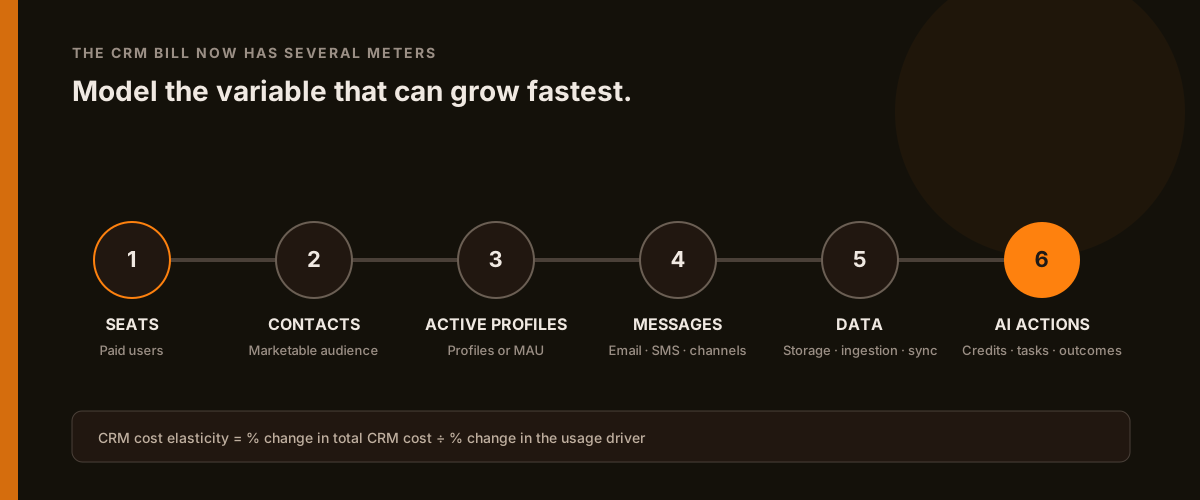
A year-one subscription price is one input. The more useful question is how quickly the bill rises when the business variable behind the meter grows.
We call that CRM cost elasticity:
CRM cost elasticity = percentage change in total CRM cost / percentage change in the usage driver
Run it against the driver that could actually move. For a sales-led company, triple the number of paid users. For a consumer brand, model ten times the active profiles and current campaign frequency. For an agentic workflow, estimate actions per case, cases per month, failure retries, and the human review cost around them.
Two products can land on the same first-year total and separate sharply at the next stage. The cheaper quote deserves little credit if its meter is attached to the fastest-growing part of the business.
That should be part of the buying decision from the beginning.
Match the CRM to the business model
Once we have an architecture and a cost model, the shortlist becomes easier to defend. “Which CRM is best?” gives way to a more useful question: “Which CRM fits the way this company creates and retains value?”
Start with the object that carries economic value, then identify the events that change its state. The table turns that logic into starting shortlists. Implementation quality, geography, compliance, existing contracts, and the surrounding stack can still move a vendor up or down.
| Business | The relationship the CRM must represent | What usually decides fit | Starting shortlist |
|---|---|---|---|
| Early-stage B2B SaaS | Account, contact, deal, founder context | Fast adoption, flexible objects, automatic capture | Attio, HubSpot |
| Scaling B2B SaaS | Marketing lifecycle, pipeline, subscription, renewal | Attribution, routing, governance, handoffs | HubSpot, Salesforce |
| Product-led SaaS | User, workspace, company, usage, expansion | Product-event integration and relationship modelling | Attio, HubSpot with a product-data layer |
| Enterprise B2B | Account hierarchy, buying group, opportunity, contract | Permissions, forecasting, CPQ, ecosystem depth | Salesforce, Microsoft Dynamics 365 |
| DTC ecommerce | Consumer profile, product event, order, repeat purchase | Real-time segmentation, activation, lifetime value | Klaviyo |
| Large consumer or app business | Active user, event stream, journey, channel | Event scale, real-time decisions, cross-channel execution | Braze, Klaviyo enterprise tiers |
| Manufacturing | Account, distributor, quote, order, installed asset | ERP connection, pricing, service, asset history | Microsoft Dynamics 365, Salesforce, SAP ecosystem |
| Professional services | Person, company, relationship history, opportunity | Context capture, simplicity, adoption | HubSpot, Attio, Pipedrive |
| Simple SMB sales | Contact, deal, task | Setup speed, usability, predictable price | Pipedrive, Zoho CRM, Freshsales |
| VC, PE, and network-led firms | Person, company, fund, introduction, deal | Flexible relationships and context | Attio, specialist relationship CRM |
Read the table horizontally. The shortlist follows from the relationship model in the middle; it is not a general ranking of the vendors.
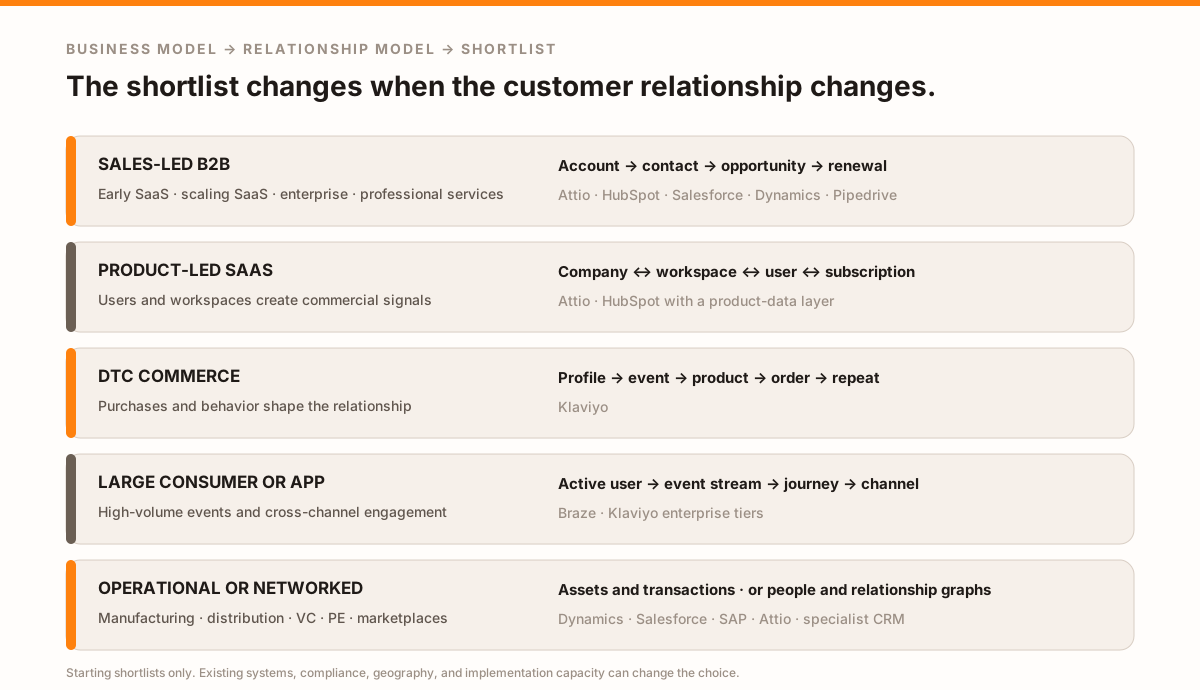
For product-led SaaS, ask vendors to show one user moving across a workspace, company, subscription, and expansion opportunity. For commerce, ask how quickly an event becomes a usable segment. For manufacturing, make the CRM respect orders, assets, and service records owned elsewhere.
Early-stage teams face another constraint: every administrative habit competes with selling time. A sophisticated model that nobody maintains is still a poor system of record. The shortlist must reflect our operating capacity as honestly as our business model.
Choose the next-stage CRM in six passes
Before the demos, prepare six short working documents. Without them, each seller defines the problem in the shape of their product. Run these passes in order and record each answer.
1. Name the relationship you are actually managing
Choose the object that best explains how the company creates and retains value: account, consumer, workspace, subscriber, distributor, installed asset, or marketplace participant. If leadership cannot agree, pause the search. We have found a business-model question that software cannot answer.
2. Draw the commercial objects around it
Draw the smallest object map that represents one customer journey. Software may need people, workspaces, subscriptions, opportunities, and renewals; manufacturing may need distributors, orders, assets, and service contracts. Give vendors the map and ask them to build it. Their compromises reveal more than a prepared dashboard.
3. Decide where customer truth is allowed to live
The CRM may own the decisive record, though Shopify, an ERP, Stripe, a product database, or the warehouse often owns part of it. For each important field, decide which system creates and updates it, how quickly it syncs, and what happens when sources disagree. “Two-way integration” means little until we know which side wins.
4. Give AI one job and one permission boundary
Choose actual work: research an account, qualify a lead, build a segment, forecast a deal, or resolve a case. Make the vendor show what the agent can read, write, approve, and trigger. Ask where logs live, when a human steps in, how retries are billed, and what remains after failure.
5. Price the business you expect to become
Build current, credible-growth, and stress cases. Include licences, profiles, messages, data services, AI usage, implementation, integration, administration, and consultants. Separate recurring spend from one-time work, then calculate cost elasticity against the variable most likely to grow. See the curve before celebrating the opening discount.
6. Try to leave before you sign
During the trial, export representative records, associations, activities, and custom objects. Check API limits, attachments, and relationship history. List the workflows, reports, identity rules, and agent instructions that need rebuilding elsewhere. A clean CSV proves the rows can leave; it does not prove the operating model can travel with them.
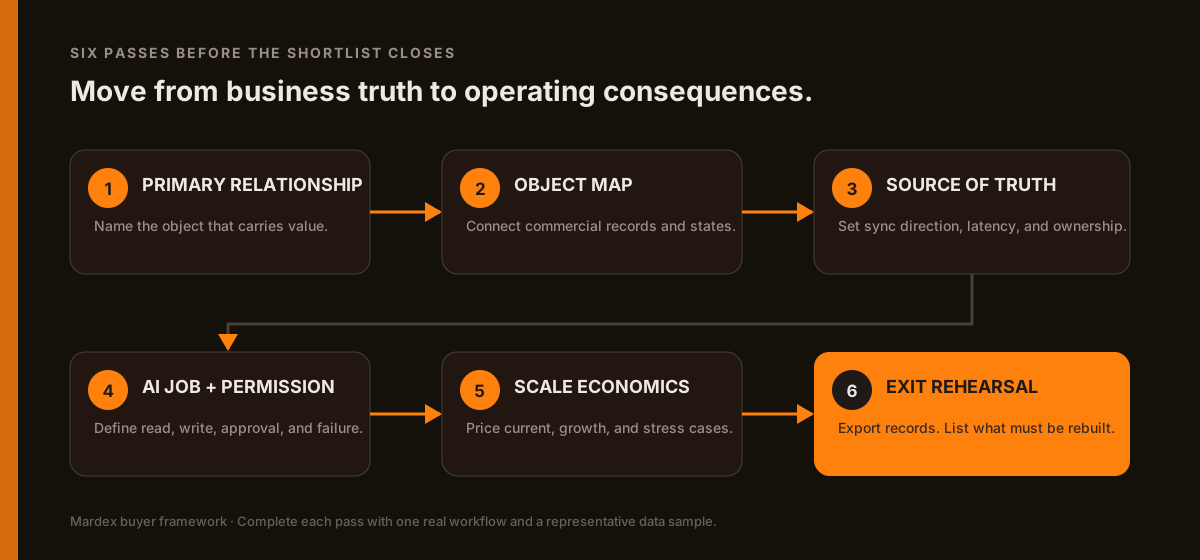
Buying teams often postpone the exit test until their leverage has disappeared. It belongs in architectural due diligence because it exposes proprietary assumptions that a feature demo rarely reveals.
No CRM can guarantee five years of fit. Aim for the next stage, with enough room to avoid trapping the one after it. Once we know the relationship, source of truth, and growth meter, vendors have to prove fit against a business we already understand. That is how a CMO turns software selection into an operating decision.